What Is the Meaning of Money?
What is the meaning of money?
Money is a tool that helps people exchange value, meet daily needs, and plan for the future. It influences almost every part of life, from basic survival to long-term success. Understanding the meaning of money helps us make better financial decisions and avoid common mistakes.
What Is Money?
Before one can understand “what is the meaning of money?” One must first define what Money is.
The definition of Money is defined by three distinct areas of its function; A medium of Exchange, a Measure of Value and a Store of Wealth.
Money provides a means of exchanging Goods and Services easily without the need to barter.
Money in the form of physical Cash, Digital Money, Account Balances or Mobile Money allows for the facilitation of many Economic Transactions.
However, the actual value of Money has no real intrinsic value. A piece of paper (Dollar Bill), or a coin (Metal), or even digital Numeric Value (Via the Internet) only has value, because collectively people have assigned value to that form of Money. Thus, what’s central to “What is the Meaning of Money”, is that it is all based on the collective and common belief shared amongst people regarding that Money (Value).
What Are Four Types of Money?
The four types of money are:
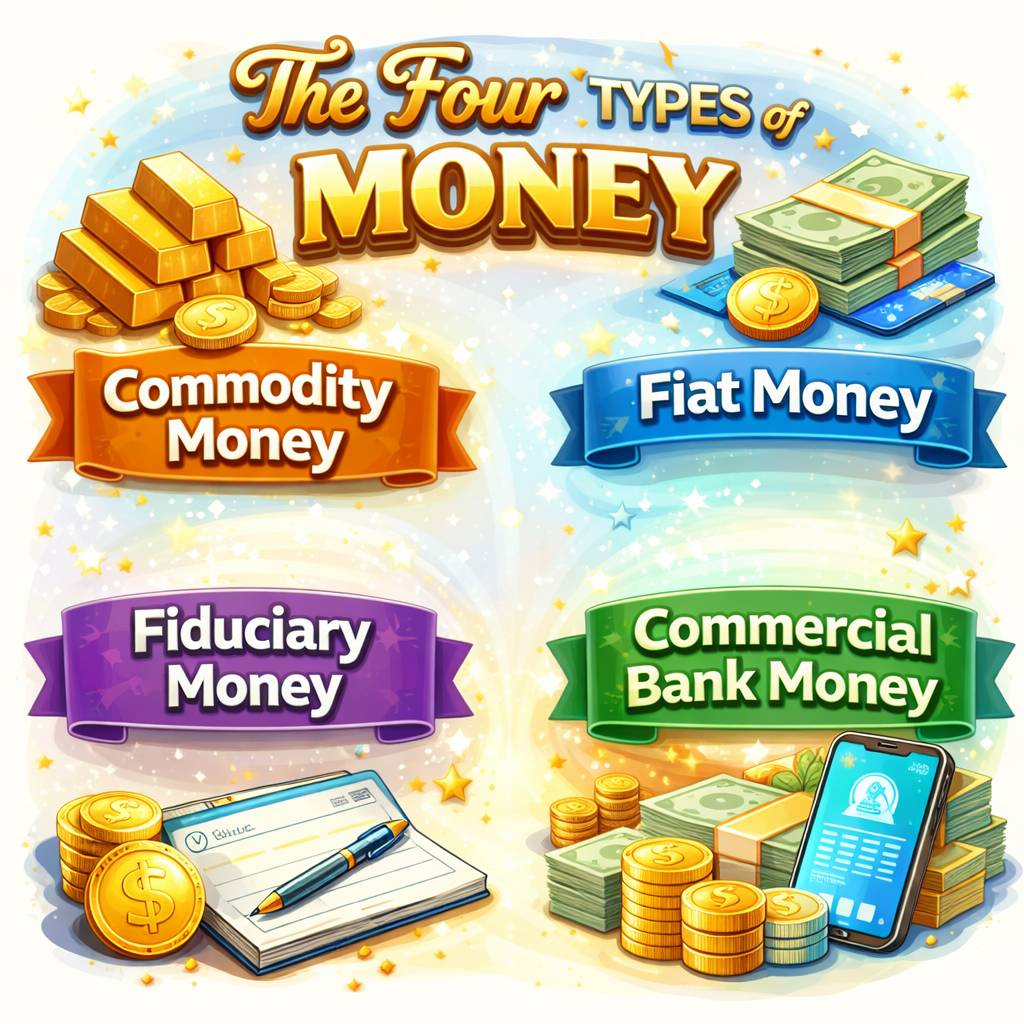
1. Commodity Money
Commodity money is money that has intrinsic value. This means the money itself is valuable, even if it is not used as money. Examples include
- Gold
- Silver
- Salt
- Copper
- Livestock
2. Fiat Money
Fiduciary Money refers to the concept of Money based on mutual trust between two or more individuals or entities. Fiduciary Money does NOT have intrinsic value and is NOT tied to a physical commodity.
- U.S. Dollar
- Euro
- British Pound
- Somali Shilling
3. Fiduciary Money
Fiduciary Money refers to the concept of Money based on mutual trust between two or more individuals or entities. Fiduciary Money does NOT have intrinsic value and is NOT tied to a physical commodity.
Examples of fiduciary money are as follows:
- Checks.
- Banknotes in some classifications
- Promissory Note
4. Commercial Bank Money
Commercial bank money refers to the balances held as digital resources in individual bank accounts, such as savings and checking account balances, as well as through electronic transfer methods. The creation of commercial bank money occurs through the loan issuance process.
The Historical Meaning of Money
History shows that, to understand the full meaning of Money, we have to look back through History to see how it evolved over Time.
The Barter System
In ancient times, People traded Goods with each other directly (Grain for Cows, Tools for Food, and other Goods). However, the limitations of this system led to the creation of Money.
Commodity Money
The use of Gold and Silver, as well as Shells and Salt, was primarily due to their value and that they are scarce. The use of these items as Money allowed us to stand for the stored labour and trust that comes with using them.
Fiat Money
Today’s modern-day Money has value simply because a Government has declared it as a Legal Tender. This change highlights that the answer to “What is the Meaning of Money?” is based on Trust rather than any Physical Item.
The Economic Meaning of Money
How does money function from an economic viewpoint? The answer lies in the ability of money to increase both efficiency and productivity.
Money allows:
- Trade and Specialization
- Market pricing of products.
- Creating opportunities for Growth in an Economy.
- Providing a means for Savings and Investment.
If we lived in a world without the functionality that money provides, Modern Economies would cease to function altogether. Businesses would not exist; employees would not be paid. The world would be unable to conduct International Trade! So when we ask “What does money mean Economically?”; the answer is that money provides Stability and Coordination for our societies.
The Psychological Meaning of Money
Psychologically, what is the meaning of money? goes far beyond economics.
For many people, money represents:
- Security
- Power
- Freedom
- Control
- Fear
- Status
Some see money as safety, while others see it as stress. Our childhood experiences strongly influence how we view money. This emotional connection is why what is the meaning of money? differs from person to person.
The Social Meaning of Money
What is the significance of Money in Society, how people perceive themselves and others when they have money and how we compare our position in comparison to others financially?
Money has the ability to:
- Create Social Class
- Influence Social Status, Authority and Respect
- Create Inequity
- Create Opportunity
In most societies today, success is measured by Wealth. These social constructs create unhealthy pressures and unrealistic expectations; Therefore, as we think about what is the meaning of money? we need to consider how we interact with each other and how Money influences the Relationships/Communities we belong to.
The Moral and Ethical Meaning of Money
So, then, the moral implications of money are found in the way an individual decides to use his/her money, based on his/her sense of responsibility to others.
One way to see this ethical responsibility is through the following examples of the ways one can use money to help others:
- To Support the Needy
- To Educate the Poor
- To Build Hospitals
On the other hand, the following actions show how money can be used in a harmful fashion:
- To Provide Funding for Corruption
- To Promote the Pursuit of Greed
- To Ruin Relationships
Ethics determine whether money becomes a blessing or a curse. Thus, what is the meaning of money? also depends on how it is earned and spent.
Money and Freedom
People consider themselves to be free if they have money. The definition of money, then, is that it provides people with choices.
Having money enables individuals to:
- Choose where they live
- Choose how to spend their time
- Remove themselves from negative environments
- Live their passions
Having money does not automatically give individuals the ability to be free. Having poor financial management can create a situation where individuals are experiencing high levels of stress and debt. Thus, the true meaning of money includes discipline as well as wealth.
Money and Happiness
Research supports the following conclusions:
- People experience increased happiness due to an increase in financial resources, up to a certain point.
- After meeting basic needs, people find that their primary source of purpose is relationships and meaning in life rather than financial resources.
- Money may provide some relief for human tragedy but will never replace the true meaning of life.
Therefore, to answer the question of what does money represent? It represents comfort rather than fulfillment.
Money as a Tool, Not a Goal
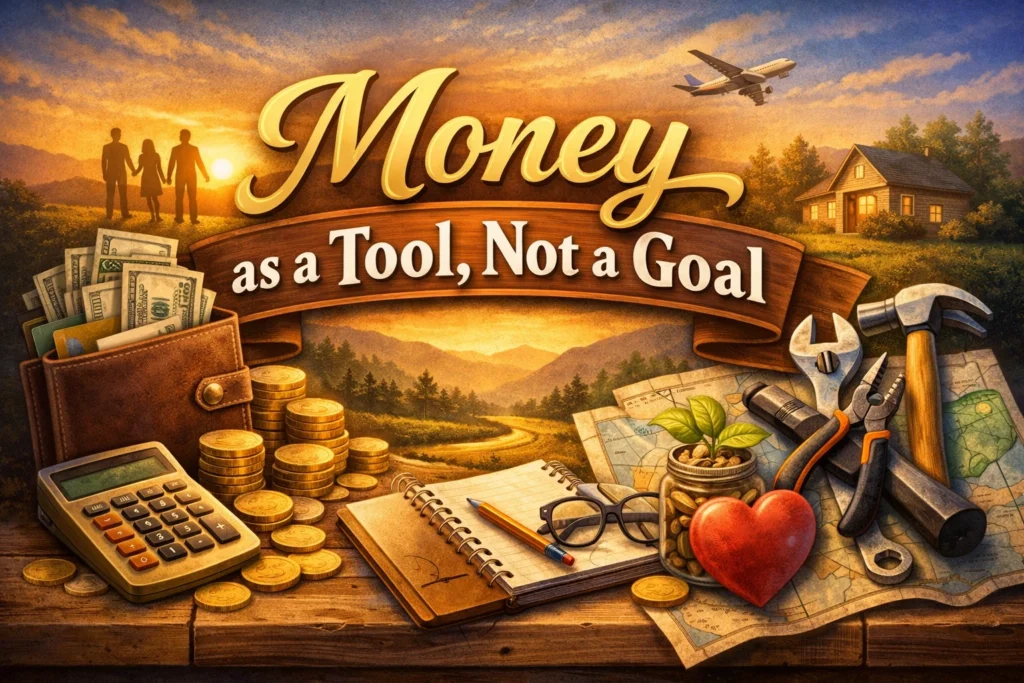
A tool, not a purpose: this is one of the first things a person must learn when attempting to understand the question “what is the meaning of money?”
Money should enable a person to experience life; it should not dictate how one will experience life. The goal of money becomes so important to someone when they use money to achieve their goal instead of focusing on their health (mental and physical), values, and relationships, that the person ultimately sacrifices their health and well-being. To change this perspective, one needs to view money as a way to live a happy and fulfilling life rather than as the sole reason to do so.
Cultural Differences in the Meaning of Money
Different cultures answer what is the meaning of money? differently.
- Some cultures emphasize saving
- Others value spending and generosity
- Some link money to honor
- Others view it as a test or responsibility
Culture shapes beliefs about money, debt, wealth, and success. This diversity proves that what is the meaning of money? is not universal.
Money and Power
Money is also a way to obtain power.
Money impacts the following areas:
- Political Groups
- Media Outlets
- Legal Systems
- Opportunities Available To People To Influence Others
Individuals who possess wealth will typically be the ones who have the greatest control over these systems. This presents a larger discussion regarding justice and equity. Therefore, the meaning of money includes holding individuals or entities accountable for their actions.
The Spiritual Meaning of Money
Spiritually, money may be equated to the intention behind its use.
A lot of spiritual traditions believe that:
- Money serves as a challenge or test
- Having material wealth holds you accountable for its appropriate use
- Sharing and giving to others, be they friends, family members, coworkers, or charities, is an important way to quicken and purify accumulated wealth
The definition of money, therefore, encompasses one’s faith in how he or she will utilize what has been bestowed upon him or her.
Money in the Modern Digital Age
New Ways to Spend, Save and Invest
Modern-day currency is primarily digital. This shift has created additional dimensions of meaning for money.
Some aspects of the digitalization of currency include:
- Cryptocurrencies
- Internet Banking
- Mobile Payments
- Cashless Societies
Although physical currency is becoming obsolete and disappearing from the economy, it is also becoming an increasingly powerful form of currency. Therefore, we must redefine how we view “money” in the context of today’s growing dependence on virtual currency.
Money and Personal Responsibility
The understanding of what is the Meaning Of Money? Is through your Personal Finance.
You will determine if Money is a source of Peace or Anxiety based on how you Budget, Save, Invest and how much Debt you have. When you learn how to Manage Your Money, you understand what Money is for, otherwise, you will wonder “What Does Money Mean?”.
Money and Legacy
Another Component ignored in answering what does “money” mean to you? is Legacy.
Money can also:
- Contribute to future generations.
- Pay for Schooling.
- Make a Difference.
Legacy is an emphasis on contributing rather than consuming. Thus, as it relates to “money”, legacy will give you the answers about “what is money?” – “continuity”, and “responsibility”.
The Negative Side of Money
An answer to the question: “what does ‘money’ mean to you?”, will also require discussion of how dangerous money can be.
Money can:
- Encourage greed.
- Tear Families Apart.
- Encourage crime.
- Create stress & anxiety.
Money (when placed above all other values) causes unaffordable life in Balance… Therefore, answers to “what does ‘money’ mean to you?,” must also include information about the potential dangers of developing an unhealthy attachment to money.
Redefining the Meaning of Money
Ultimately, what is the meaning of money? is a personal definition.
- For some, it is security.
- For others, it is opportunity.
- For many, it is a test of character.
The healthiest definition of what is the meaning of money? is seeing it as a resource to support a meaningful life, not replace it.
Conclusion: Meaning of Money?
When considering money as a whole, we can start by thinking of money as a currency but it’s much more.
The meaning of money cannot be summed up by only thinking of it as a monetary unit of measure. Money is a representation of trust, power, responsibility, choice, and freedom. It is a reflection of our character, values and it also shapes our society. When used properly and wisely, money becomes a means of growth, generosity and security; but if misunderstood, money can be a source of anxiety and division. Understanding Money will enable us to have control over our financial situation and ensure that we are not controlled by it.
Recommendation
- Why Most People Fail Saving Money
- Index Funds vs Individual Stocks.
- How to Start Making Money on YouTube: The Complete Guide for 2026.
- How to Make Your Money Work For You: The Path to Financial Freedom
- How to Start an Online Business: Your Ultimate Step-by-Step Guide