
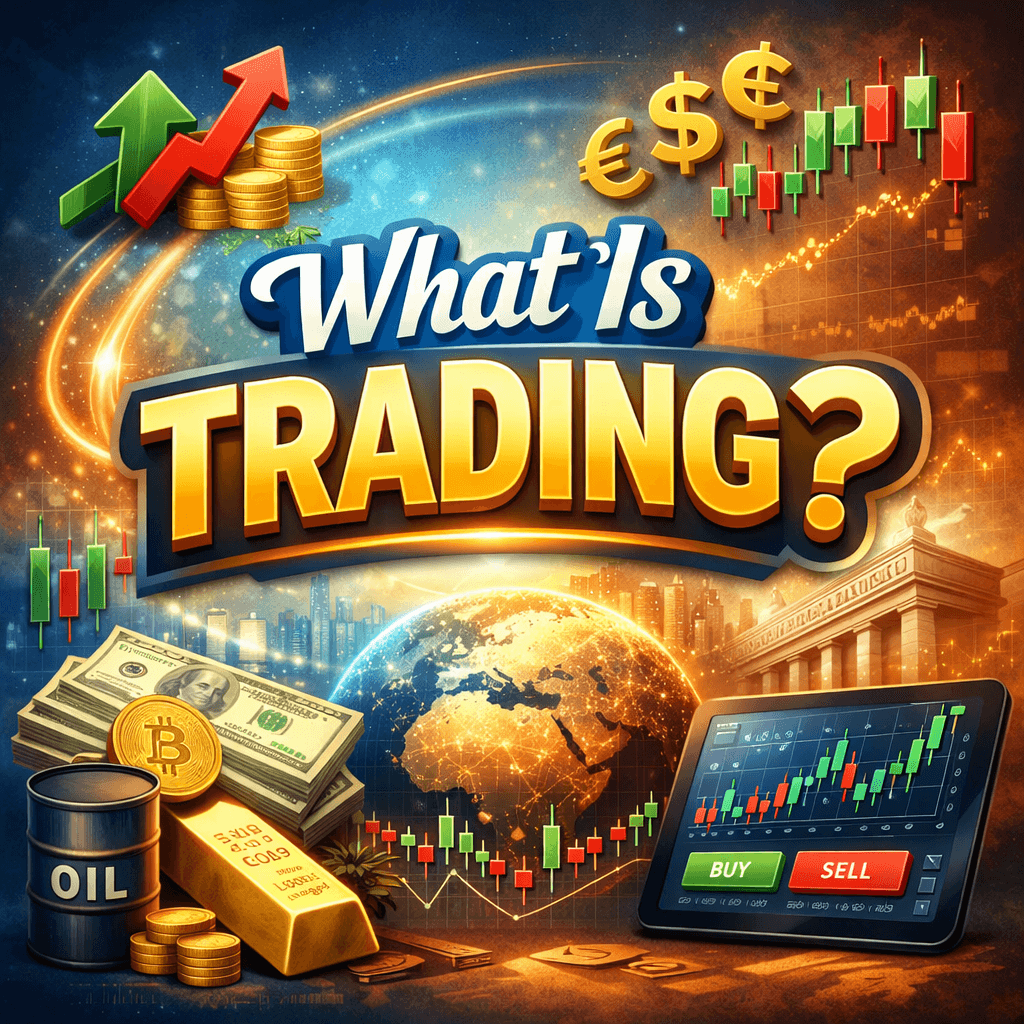
Trading is an economic activity where individuals or institutions exchange assets in financial markets. These assets can include stocks, bonds, foreign currencies (forex), commodities like gold and oil, and digital assets such as cryptocurrencies.
The main purpose of trading is profit. Traders aim to buy an asset at a lower price and sell it at a higher price. In some cases, traders can also profit when prices fall by selling first and buying later (this is called short selling, though it has specific rules).
Trading has existed for centuries, starting with simple barter systems and evolving into complex global financial markets supported by technology, banks, and online platforms.
What Is Trading?
Trading is an element of the economy regarding how people/institutions buy/sell goods and services (assets) through the markets. The types of tradeable goods or services (assets) can vary based on numerous factors. Examples of tradeable goods and services (assets) include: equities (i.e., Stocks), Fixed Income Securities (i.e., Bonds), Foreign Currencies (FOREX), Commodities (i.e., Gold and Oil), Digital Assets (i.e., Bitcoin and Ethereum).
The primary goal of trading is to generate a profit. Traders will attempt to purchase an asset for less than it will eventually sell for, generating a profit on each transaction executed. In certain instances, traders/sellers can also realize a profit by selling before an asset decreases in value, known as short selling (#2), but there are specific regulations defining this process.
Trading originated hundreds of years ago as a simple form of bartering and has now expanded into complex globalized financial markets and transactions facilitated through advancements in technology, banking institutions, online trading platforms (e.g., TD Ameritrade, Coinbase, etc.).
How Does Trading Work?
Financial Markets is how Trading Done. Through these Markets, buyers and sellers are connected. These Financial Markets can be classified into either physical markets e.g. traditional stock exchanges, or Digital markets e.g. Online Trading Platforms.
Below is a step-by-step description of how Trading usually occurs:
- Select a market of interest to trade (e.g. Stock/Fx/Crypto).
- Create an Account with a Broker/Trading Platform (i.e. Security Firm).
- Research the Financial Markets Regionally/Internationally, utilize Technical Analysis Tools, News & Data.
- Submit a Buy/Sell Order via your Broker/Trading Platform.
- The Market connects your Order with another Trader, allowing you to either Profit or take a Loss depending upon how your Market Price movement changes post-Execution of your Trade based on your Market Analysis.
- Electronic Systems & the Internet allow for faster execution today, greatly decreasing the time required from Trade Placement to Completion vs the days, weeks, or Months it took.
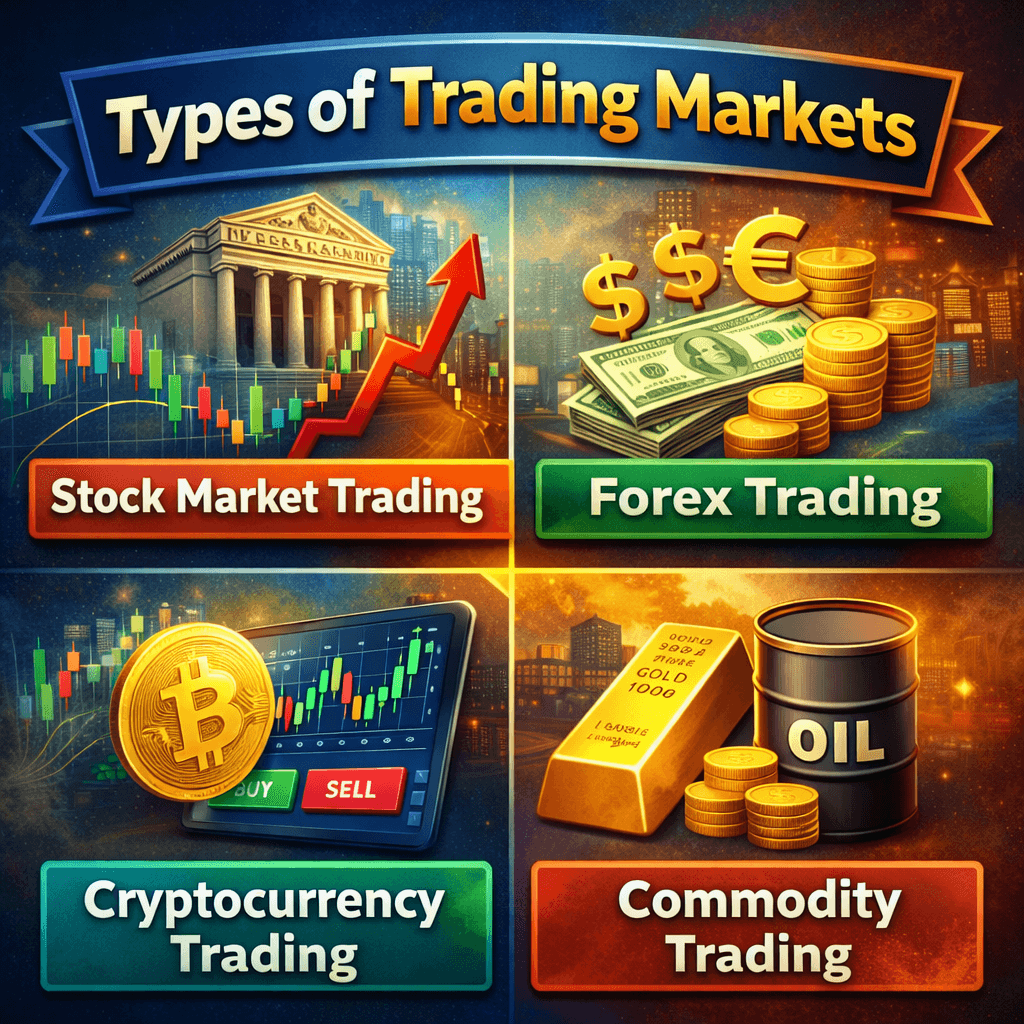
Types of Trading Markets
1. Stock Market Trading
Buying or selling shares in a company is known as stock trading. When you purchase a stock, you’re buying part ownership of that particular company.
Notable stock exchanges are:
- New York Stock Exchange (NYSE)
- NASDAQ
- London Stock Exchange
When making investment decisions traders generally take into consideration how well a particular company has performed, its earnings report, as well as how other current market environments (e.g., Economic conditions) impact company stock price.
2. Forex Trading
Forex (foreign exchange) trading happens when a trader buys a currency and sells another currency simultaneously (for example, USD/EUR and GBP/JPY).
The forex market is:
- The largest Financial market globally
- Open 24/7 (except for Weekends)
- Very liquid
Forex traders take into account multiple variables (e.g., interest rates, inflation, political factors, international economic news, etc.) when making their trading decisions.
3.Cryptocurrency Trading
Crypto trading is characterized by a digital currency (such as Bitcoin, Ethereum, etc.)
The Crypto market is known for its:
(i) Highly volatile pricing
(ii) 24-hour-a-day trading
(iii) No central authority
Due to these market characteristics, Crypto traders must accept increased price volatility compared with other financial assets, but they also face increased potential profits when trading this product.
4. Commodity Trading
Those commodities consist of:
- Gold
- Oil
- Wheat
- Silver
Commodity markets operate similarly to stock and fx markets by responding to both supply/demand(s) and external factors (e.g., Weather Patterns, Geopolitics, Long-term ongoing production, etc.).
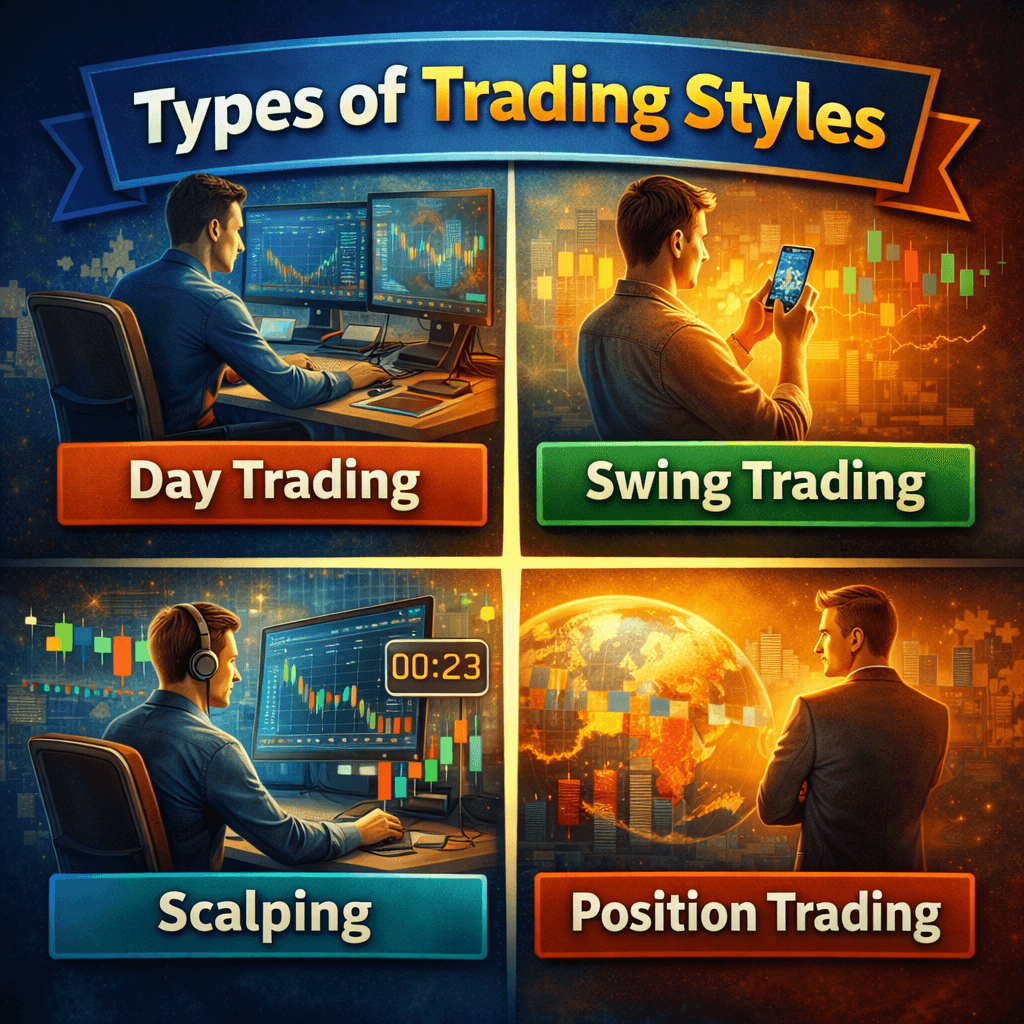
Types of Trading Styles
1. Day Trading
Day Trading In day trading, the trader opens and closes the trade on the same day, so there is no carry over of a trade to the next day. This style requires quick decision making ability, focus and the ability to manage high risks.
2. Swing Trading
Swing Trading The swing trader, will hold the trade for a period of days to weeks, trying to profit from the movements in price that typically happen over the medium term. The swing trader does not have to keep their eyes glued to their screen and has more time to analyse their trading opportunities, balancing reward versus risk before entering a trade.
3. Scalping
Scalping Scalping is the shortest time-frame type of trading style, looking for small changes to occur to the price of a stock over minutes or seconds. Scalpers typically make a large number of trades on a daily basis, looking to profit from the small changes. Scalpers need to make fast execution decisions and have a good deal of discipline when it comes to managing their trades.
4. Position Trading
Position Trading Position trading is the longest term of all trading styles, with the trader holding the trade for months to even years. The position trader operates similar to an investor and therefore relies on a good deal of fundamental analysis.
How Traders Analyze the Market
technical analysis
Using technical analysis, traders examine historical price patterns and indicators on charts, predicting the likelihood of future price fluctuations.
Many technical resources include the following:
- Support and resistance levels
- Moving average values
- RSI (Relative Strength Index)
- Candlestick charts
fundamental analysis
Using fundamental analysis, traders assess economic indicators, financial reporting, and worldwide news. For instance, some examples of fundamental analysis are:
- Earnings of a company
- Interest rate information
- Inflation rates
- Economic growth rates
Generally, traders combine both technical and fundamental analyses together to aid in their decision-making processes.
What Is a Trading Strategy?
A trading strategy is a stepping stone or plan to follow.
The strategy defines your entry and exit points, as well as how much risk you will take. Strategies can range in skill level, from simple to complex, but your strategy will always contain a risk management portion.
Risk Management in Trading
Risk management is one of the most important aspects of trading. Key risk management rules include:
- Never risk more than you’re comfortable losing.
- Always use stop-loss orders.
- Do not trade excessively.
- Don’t let greed and fear control you.
Many traders lose money not because trading isn’t going to work, but because they ignore the concept of risk management.
Is it hard or easy to trade?
Trading is easy to learn, but difficult to become skilled at. You can open a trading account, but for consistent success, you need:
- Education
- Practice
- Discipline
- Patience
Most beginning traders will lose money initially. Successful traders view trading as a skill that develops over time, not as a quick get-rich-quick scheme.
| Trading | Investing |
|---|---|
| Short-term | Long-term |
| Frequent buying/selling | Buy and hold |
| High involvement | Less active |
| Higher risk | Lower risk |
Can Trading Be Halal or Haram?
In Islam, trading itself is not haram, but it must follow Islamic principles.
Trading becomes haram if it involves:
- Riba (interest)
- Gharar (excessive uncertainty)
- Gambling-like behavior
- Haram assets
Islamic scholars encourage ethical, transparent, and responsible trading.
Trading commonly makes errors some beginners may make
- Being ignorant about trading
- Social media signals
- Improper use of risk management systems/methods
- Relying on small victories
- Making decisions based on emotions
Avoiding the mistakes mentioned above can help you establish yourself for long-term success.
To conclude: What Is Trading: How Does It Work?
Trading is an activity that many people participate in globally to grow their wealth. Although it is not a certain science and/ or a lucky business, trading follows a structured process for understanding the markets, analyzing them, and exercising personal discipline and controlling risk. An Brief understanding of how to trade will allow the beginner trader to have realistic expectations when entering the market and thereby avoiding the traps that others have fallen into. With education and patience, all types of traders can be successful, whether trading stocks, Foreign Exchange, or Cryptocurrencies.
Recommendation
- Why Most People Fail Saving Money
- Is Trading Halal in Islam?
- How to Start Making Money on YouTube: The Complete Guide for 2026
- How Do I Improve My Money Mindset?
- What Is the Meaning of Money?