
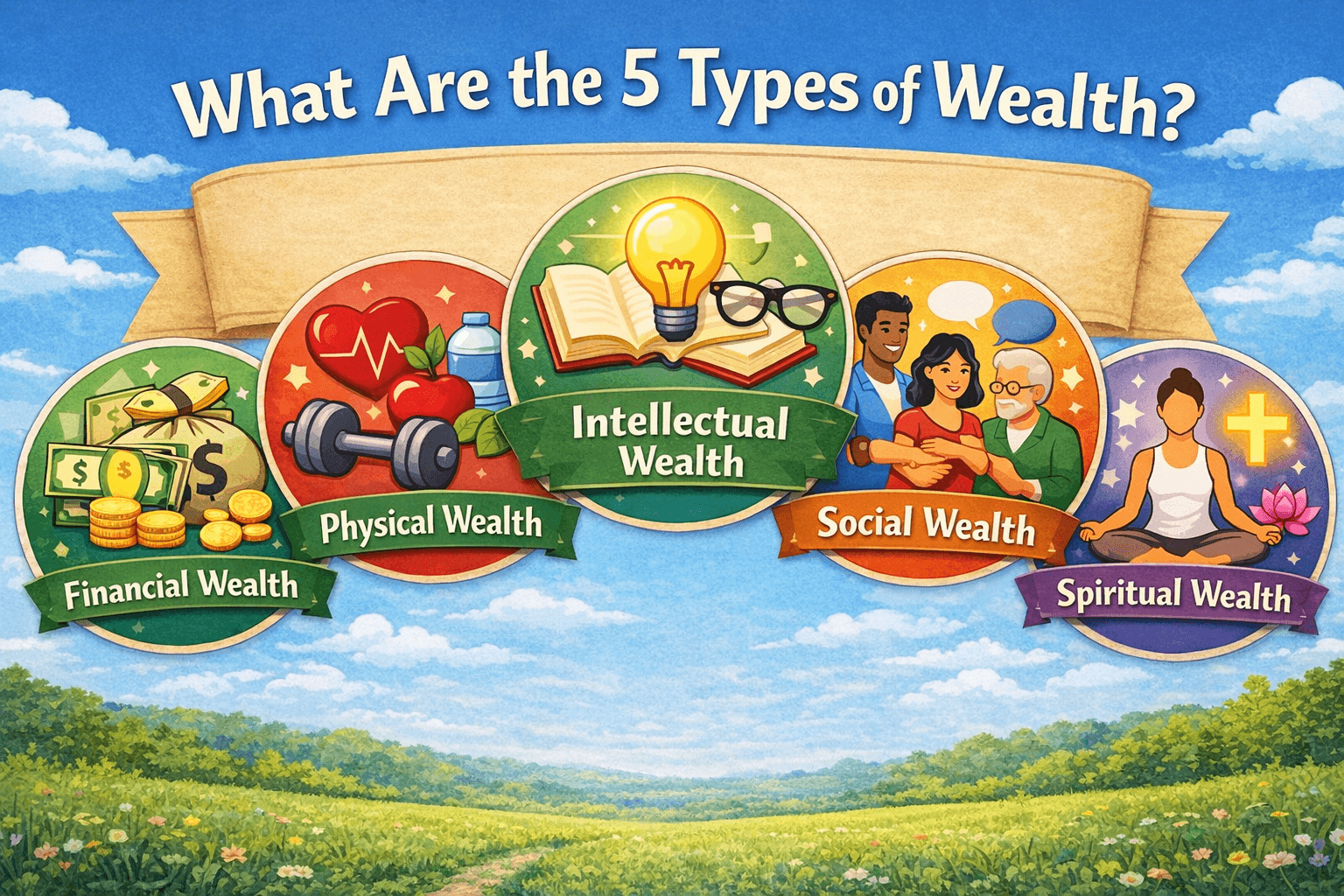
When most people hear the word wealth, they immediately think of money—cash in the bank, a big house, or an expensive car. While financial success is important, true wealth is much broader and deeper than just money. A person can be rich in cash but poor in health, relationships, or peace of mind. On the other hand, someone with modest income may feel deeply fulfilled because they are rich in other areas of life.
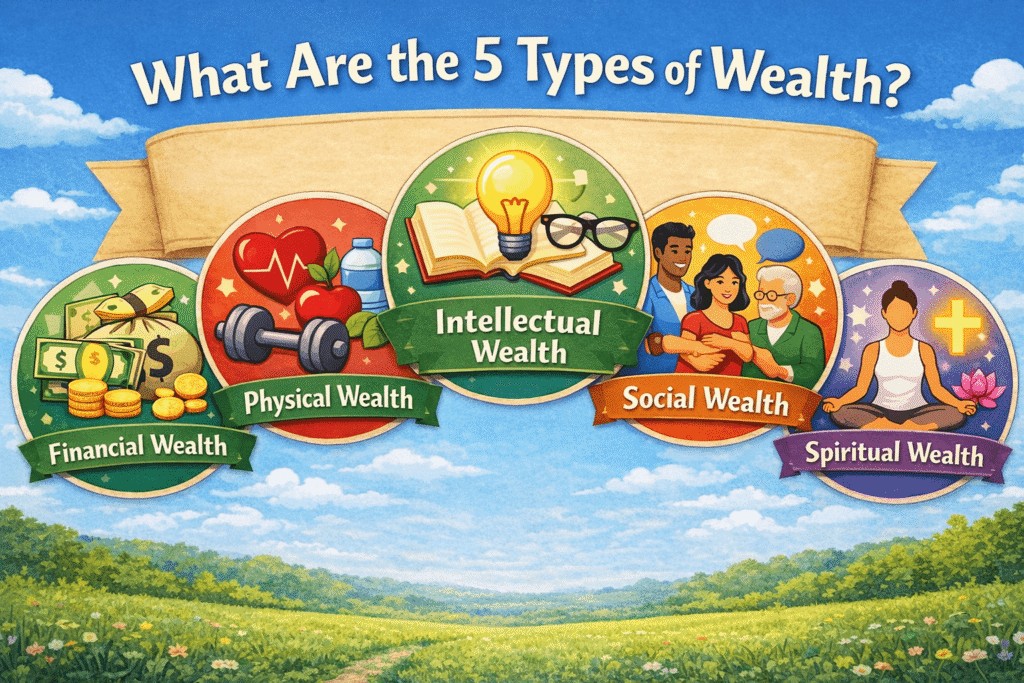
What Is Wealth?
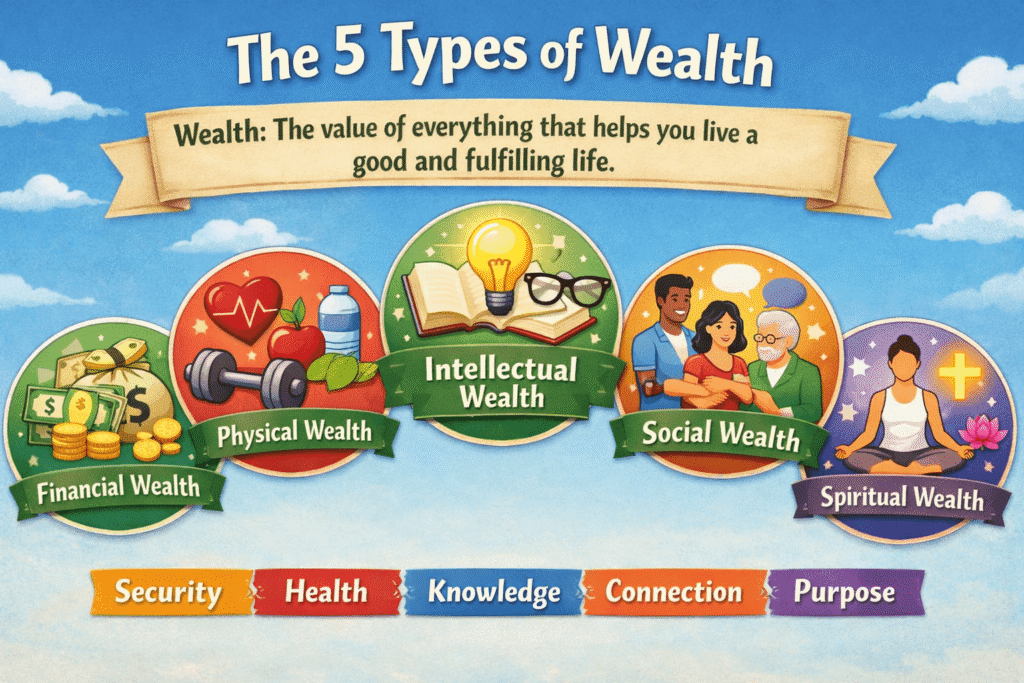
Wealth is the overall value of what a person has that improves their life. It includes money and possessions, but it also includes health, knowledge, relationships, and inner peace.
In simple words:
Wealth is everything valuable that helps you live a good, secure, and meaningful life.
Many people think wealth only means being rich in money. But real wealth is broader. A person can have a lot of money but feel unhappy, unhealthy, or lonely. That means they are financially wealthy but poor in other areas.
True wealth is about having resources—both material and non-material—that give you:
- Security
- Freedom
- Stability
- Happiness
- Purpose
For example:
- If you have money → you have financial wealth.
- If you have strong health → you have physical wealth.
- If you have knowledge and skills → you have intellectual wealth.
- If you have supportive family and friends → you have social wealth.
- If you have inner peace and faith → you have spiritual wealth.
So wealth is not just about what is in your wallet. It is about the total quality of your life.
Understanding the different types of wealth helps us build a balanced and meaningful life. Instead of focusing on only one area, we can grow in several dimensions that support long-term happiness and success. In this article, we will explore five major types of wealth: financial wealth, physical wealth, intellectual wealth, social wealth, and spiritual wealth.
1. Financial a Wealth
Financial a Wealth of Money is the Most Recognised Type of Wealth; a Wealth of Money to people, refers to all of the Assets, Property or Resources that have a monetary value. Examples of financial a Wealth of Money are Savings Accounts, Investments, Real Property (home), Business Ventures or any other form of Financial Resources that provide Security & Opportunity.
Financial a Wealth of Money can be used by individuals (depending on their financial resources) in order to meet their basic needs for shelter, Food, Clothing, and Education; these needs would be a basic form of utility.
Anything that exceeds the basic survivorship need of utility, such as comfort, freedom and opportunity, is considered abundance. A person with high levels of Financial a Wealth of Money may spend their Financial a Wealth of Money on, depending on their values, things such as education, entrepreneurship, travel, or donating to a charity.
Typically financial resources are developed through discipline and responsible planning. Building Financial a Wealth of Money usually requires the use of Budgeting, Saving, Investing appropriately and avoiding excessive debt. Additionally, financial intelligence (the ability to understand how money works) is important. Financial resources can be lost in an instant if one lacks knowledge, discipline, self-control, etc.
Although financial resources have their importance in our life, we should not only focus our attention on Financial Wealth. Individuals who focus all of their attention on Financial Wealth commonly do so at the expense of their Health, Family & Relationships and/or Peace of Mind. True success combines both Financial Wealth and other forms of Wealth (Emotional, Physical, etc).
2. Physical wealth
Physical wealth is defined as your health, strength, energy and overall well being. Without good health, it can be nearly impossible to enjoy other kinds of wealth. A person could have millions of dollars in wealth, but if that person is experiencing illness or has weakened physical capabilities, then their quality of life will be diminished.
Physical wealth can be measured in terms of your nutrition, frequency of exercise, sufficient amount of sleep, access to medical care and mental state – as the body and mind are completely and irrevocably connected to each other. Both physical and mental wealth can suffer from daily stressors, anxiety and other poor lifestyle choices/daily habits, resulting in a deterioration of both physical and mental levels of wealth over time.
Taking care of your physical body is similar to maintaining a successful investment. Good habits, such as exercising, drinking plenty of fresh water daily, and eating a balanced diet, performed every day will produce the same overall results as good investments do over a long period of time. Prevention, in nearly every circumstance, will yield better results than treating negative conditions after they develop. Building positive habits and routines early in life will result in a lower incidence of developing chronic health conditions in the future.
Furthermore, developing strong levels of physical wealth will generate a higher level of productivity in all aspects of your life. If you have a lot of energy and strong levels of physical capability, then you can work more efficiently, study more efficiently, and pursue the things you want to achieve at a greater level of success. Investing time/ effort into building your physical / mental wealth is just as important as investing money into a savings account.
3. Intelligence as Financial Capital
Intellectual Resources comprise all your knowledge, capabilities, creativity, and critical thinking. They also relate to a greater level of education, greater experience, and your ability to become an intelligent human being by learning and adapting. There is no possibility to ever lose your Intellectual Resources as they stay with you and often grow with your progression through the world.
While in many cases education is an important factor in building your Intellectual Resources, it is not the only way to create an increase in your Intellectual Resources. Other ways to increase your Intellectual Resources include reading; listening to Podcasts; obtaining knowledge from workplaces; or obtaining knowledge from experienced mentors. Curiosity and a desire to continuously grow are critical in creating your Intellectual Resources.
In an ever-changing environment with advances in technology occurring daily and industries and job markets evolving rapidly, your Intellectual Resources are of great importance. Those individuals who continuously learn and improve their skills will have a greater chance of succeeding and being able to adapt to the changes that are inevitable in life.
Your Intellectual Resources provide you with the ability to Problem Solve and make good decisions. With the ability to think critically you will be able to evaluate circumstances and make informed decisions based on the facts you gather. Many times they are the basis of your ability to create financial advantages because your knowledge and skills offer you opportunities.
4. Social Capital
Social capital is the social networks, relationships, and the strength of your connections to other people. Since we are social creatures, we rely on our family members, friends, co-workers, and communities for cooperation, support, and love.
Having strong relationships gives us emotional support during tough times and also produces opportunities for us. Many job and business opportunities may arise because of a personal connection. Trust and reputation are two main elements of social capital.
One must develop social capital by expressing kindness, communicating honestly, being trustworthy, and treating others respectfully. Developing social capital takes time and effort. To maintain a relationship, you must listen to others, assist them, and express gratitude towards them. Social capital is not about having a large number of followers on social media; it is about developing and maintaining relationships that are both meaningful and supportive.
Communities that have higher numbers of social capital also tend to be more cooperative and stable as a result. When members of a community have trust in each other, they are more likely to work together effectively to find peaceful solutions to problems. At the individual level, social capital has a significant impact on happiness and life satisfaction.
On the contrary, lack of social capital can have negative effects on a person’s health both physically and mentally. Therefore, building and maintaining social capital is one of the most critical components of an individual’s overall capital.
5. Spiritual Wealth
Spiritual wealth has to do with having an internal sense of peace, purpose, value and connection to something bigger than yourself; for many it may be defined as having a religious faith or belief in a higher power. Others view spiritual wealth through their personal values and beliefs. Regardless of the specific belief system, there is a strong sense of having meaning in ones’ life when they possess spiritual wealth.
When someone has a strong sense of spiritual wealth, they will generally feel a level of stability and peace in themselves even when faced with difficulties.
Prayer, meditation and other similar practices help strengthen the sense of spiritual wealth.
Coping with stressful situations as well as loss and uncertainty is made easier by developing a system of spirituality. Although financial wealth can provide some level of comfort, true satisfaction and fulfillment occurs because of the development of spiritual wealth.
Many of today’s successful people have stated that when they don’t have purpose in their lives they aren’t really happy with money alone; therefore, developing a relationship to one’s own spirituality will enable one to align what they do with the values they hold and create a sense of balance in their life.
The Value of Balance
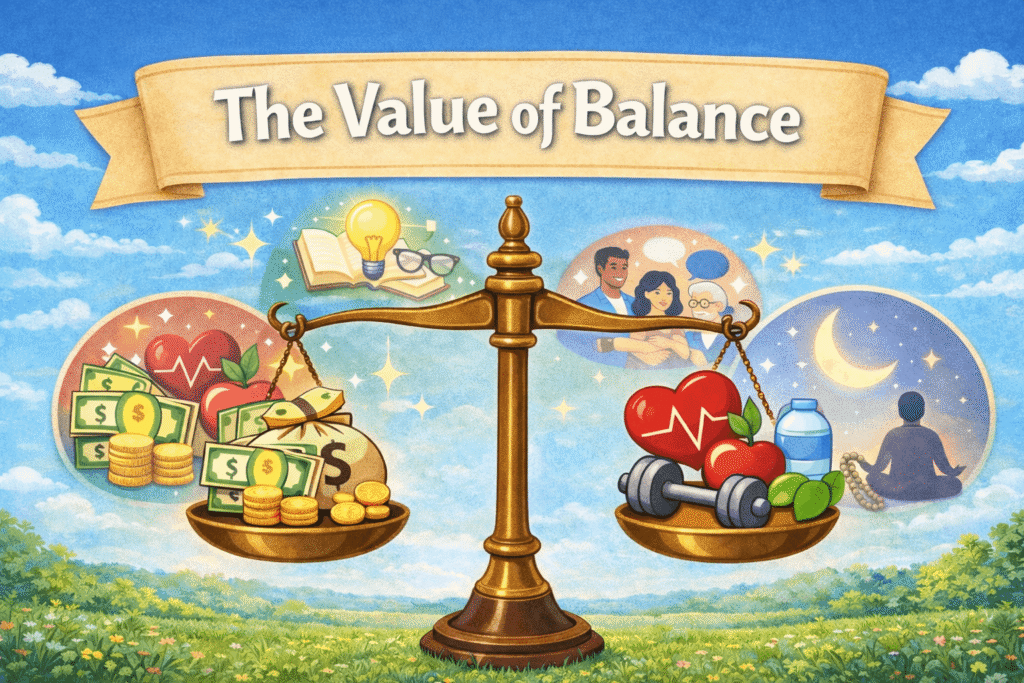
All forms of wealth support each other. For instance, wealth in the area of education can help contribute toward building financial wealth. Likewise, having financial wealth gives you greater access to healthcare, which can contribute to physical wealth. Having wealth socially will provide emotional support that can, in turn, help strengthen mental and spiritual wealth.
Focusing all of your energy on one type of wealth and not enough amount of energy on the other three can lead to an imbalance. For example, someone who works non-stop to earn money may negatively impact their physical health and have issues with friends and family. On the other hand, someone who only focuses on developing spiritually, yet does not take care of their responsibilities (like paying the bills), can end up in financial hardship.
The objective is not to attain perfection, but rather to achieve balance. Since life is always changing, what is important to you at one point in time may not always be so important to you later on. For instance, building up your financial wealth may be the main priority for you at one point in your life and improving your health or maintaining strong relationships may take priority over building up your financial wealth at another point in your life.
Conclusion
Wealth is not limited to money. True wealth is multi-dimensional and includes financial, physical, intellectual, social, and spiritual aspects. Each type plays a vital role in creating a fulfilling and meaningful life.
Financial wealth provides security and opportunity. Physical wealth ensures health and energy. Intellectual wealth builds knowledge and adaptability. Social wealth strengthens relationships and community. Spiritual wealth offers purpose and inner peace.
When we understand that wealth is more than money, we can make better choices about how to spend our time and energy. By investing in all five types of wealth, we create a balanced life that leads not only to success but also to happiness and long-term well-being.
Recommendation
- Why Most People Fail Saving Money
- Is Trading Halal in Islam?
- How to Start Making Money on YouTube: The Complete Guide for 2026
- How Do I Improve My Money Mindset?
- What Is the Meaning of Money?
- What Is Trading and How Does It Work?